|
CLTC UC Davis Parking Garage Case Study:
  Development Partners: California Energy Commission’s Public Interest Energy Research
(PIER) Program, California Lighting Technology Center, Full Spectrum Solutions, Inc.,
Watt Stopper/Legrand
Demonstration Partners: UC Davis Energy Efficiency Center, UC Davis Facilities Management
Development Partners: California Energy Commission’s Public Interest Energy Research
(PIER) Program, California Lighting Technology Center, Full Spectrum Solutions, Inc.,
Watt Stopper/Legrand
Demonstration Partners: UC Davis Energy Efficiency Center, UC Davis Facilities Management
UC Davis Parking Garages Shine with Smart Fixtures
|
California Lighting Technology Center (CLTC) partnered with California Energy Commission′s
Public Interest Energy Research (PIER) Program, Full Spectrum Solutions, Inc., and Watt
Stopper/Legrand to develop a bi-level occupancy based induction luminaire for exterior deck
or ceiling mounted applications. This innovative product reduces energy consumption and
maintenance costs.
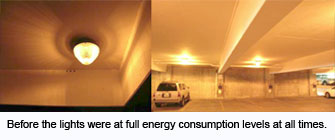
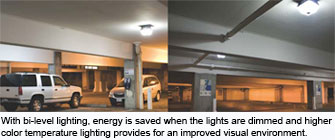
The bi-level luminaires reduce light levels to 50% when the space is unoccupied, saving
energy and reducing light pollution. When motion is detected, they return to full brightness. To
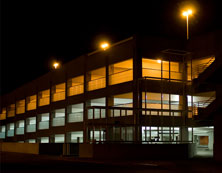
test the product, eight fixtures were installed at the UC Davis North Entry Parking Structure.
Data collected from the demonstrations indicates a 30–40% reduction in energy consumption.
The test was completed as part of the UC Davis Smart Energy Initiative Garage Lighting
Project, a statewide energy saving initiative in collaboration with the UC Davis Energy
Efficiency Center.
|
Driver and pedestrian safety are key concerns in parking area lighting design. Until now, the
accepted belief was that a brightly lit area is safer. To the contrary, current research indicates
that a system that responds to occupancy provides more beneficial information than one that
is always in the same mode. If a security guard is overseeing a garage that is at 50%
brightness and the lights come to full power in specific places, there is a targeted area to
monitor. Additionally, the high correlated color temperature (CCT) of 5000 K provides for
better visibility and color differentiation. Blue and green cars that were difficult to distinguish
between under the former high-pressure sodium lights are now clearly rendered with the light
from the induction lamps. Research has also shown that bluer light is more effective in low
light level situations.
Energy savings are only one portion of the overall reduction in resource use. The EverLast®
100 Watt Induction Lamp is designed to last for 100,000 hours, which translates to
approximately a 20 year lamp replacement cycle. Maintenance costs are reduced due to a
longer lamp lifespan compared to alternative lamp choices. When a luminaire requires little or
no attention, maintenance resources may be reallocated. Emissions from vehicles used to
replace lamps are minimized. Landfill waste from failed lamps, including mercury, is also
reduced. Over the life of the induction lamps, more than seven of the traditional lamps would
fail. This means that more than 8000 lamps will be eliminated from the waste stream after the
new lighting system is installed.
LED products show great promise in the energy efficient lighting development effort, but the
high first cost is still an obstacle for many buyers. Induction lighting offers a lower first cost
alternative combined with significant energy use reduction. Facilities managers with immediate
lighting needs are looking for proven, market-ready technologies. The energy savings
demonstrated at the test site makes induction lighting an ideal technology for retrofitting
existing parking structures at campuses, shopping centers, and urban city centers. After
evaluating the results from the initial installation, UC Davis Facilities Management has
committed to retrofitting four large parking garages that contain more than 1000 luminaires.
The impact of this commitment is two-fold. Facility managers will see the cost and
maintenance savings. The estimated annual energy savings for the four structures is $77,127,
based on the discounted university utilities rate of 9¢ per KwH. Maintenance savings are not
included in this estimate. Employees, students, and citizens will continue to use a well-lit
parking structure, but will be able to see the stars a little clearer if they live nearby or pass by
an unoccupied garage at night. As the adoption of more efficient lighting technologies
increases, and awareness and acceptance of multi-level lighting increases, energy
consumption will decrease and help UC Davis and the state of California reach their efficiency
goals. In five years, perhaps we will all wonder who left the lights on when we pass by a fullylit
parking area at night. This project is one step towards that goal.
|
|